
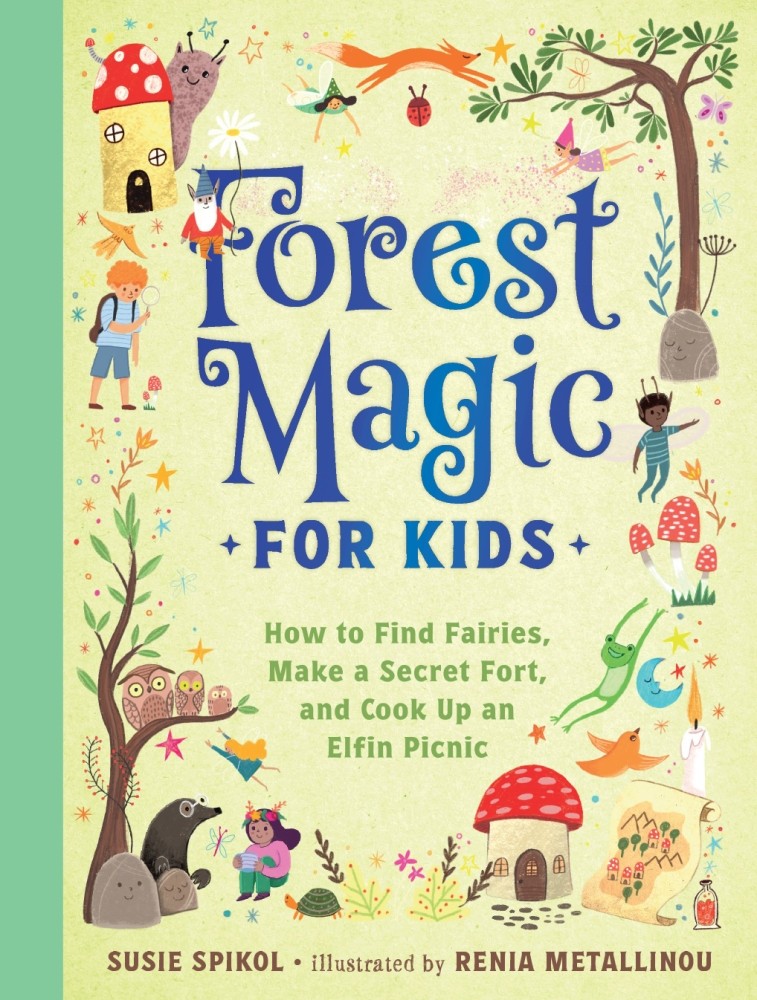
by Susie Spikol
Gibbs Smith, 2025
In a world where children are spending more time on screens, Forest Magic offers inspiration for young people to venture outdoors. Susie Spikol is a parent, educator, and author who feels strongly about the importance of wonder in children’s interactions with nature. Her book educates readers – both children and their teachers – about the science of their surroundings, while also posing questions that encourage further exploration. She suggests a wide range of nature-based activities to spark imagination, each with a materials list and instructions.
The book is divided into six themed chapters. The first one focuses on plants, with activities such as observing a special tree, as well as creating wands, walking sticks, and leaf crowns. Things take a culinary turn in the next chapter, with recipes for tea made from flowers, solar-oven nachos, and elfin bread. Chapter 3 highlights the magical world of fungi, encouraging readers to collect spore prints and search for fairy rings or bioluminescent mushrooms. The fourth chapter explores forest-dwelling creatures, both real and imaginary, and includes ideas for building gnome homes, tracking queen bees, and discovering animal dens. Chapter 5 inspires readers to find or create hideaways of their own, such as indoor or outdoor forts or nests. Throughout the book, Spikol encourages readers to look for magical creatures, and in the final chapter – in case readers haven’t yet spotted any in the wild – she shares ways to craft “wee folk” from simple supplies including twigs, clothespins, and yarn. Renia Metallinou’s illustrations throughout the book are whimsical and full of color and life.
Readers can skim through Forest Magic for an activity that catches their eye or read the entire book cover to cover. Either way, they will soon want to put it down (or bring it with them!) and head outside with their nature journal. Forest Magic is a wonderful resource for parents, guardians, or teachers looking for outdoor activities for their children. Under each activity title there is a sidebar labeled “Build Your Skills” that lists the particular skills that activity strengthens, such as planning, observing, climbing, or storytelling.
Some sections encourage children to be by themselves and practice mindfulness and reflection, while others inspire them to invite friends into their play. Spikol also introduces organizations doing important ecological work, encouraging readers to “find out more about how to protect bumblebee habitats by checking out Xerces Society’s webpage,” or “contribute to community science projects like Nature’s Notebook, a program run by the USA National Phenology Network.” In this way, the book serves as an entry point to deeper exploration.
Spikol emphasizes that nature is magical and unlimited, and that it is for everyone. She includes information about how people from around the globe have interacted with the natural world throughout history, both in practical and magical ways, including a mix of Western and non-western perspectives. Spikol grew up in New York City, and she emphasizes that the kind of forest magic she describes can be found anywhere, even in the cracks in the sidewalk, or the space between two city buildings. The book is not limited to those who have access to nearby woods – anyone with a sense of curiosity and wonder can enjoy the natural world.